By Pavel Bawa, Principal Broker & Managing Director, Aumera Estates
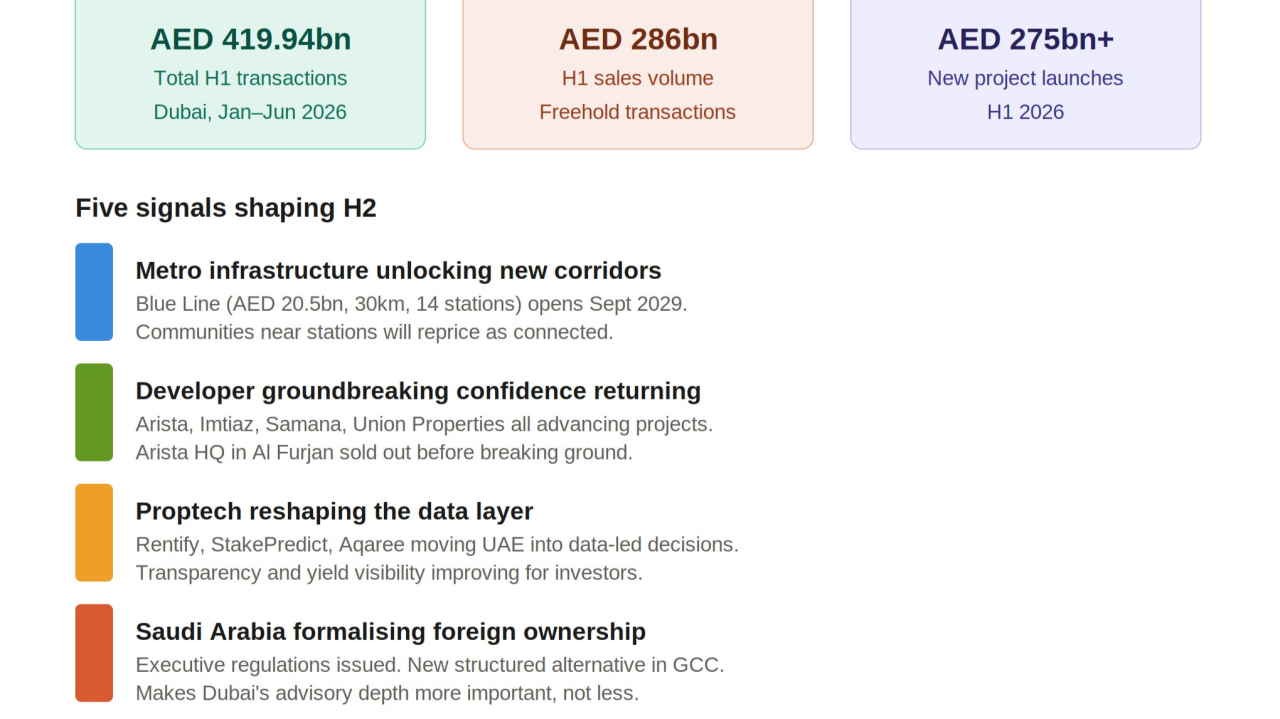
Dubai closed the first half of 2026 with AED 419.94 billion in property transactions. New project launches exceeded AED 275 billion. Sales volume crossed AED 286 billion. These are not incremental gains, they represent a market operating at a scale that demands a different analytical lens than year-on-year comparisons can provide.
But the H1 number, as impressive as it is, is almost the least interesting thing about where Dubai real estate stands today. What's more instructive is what's being built around it.
Infrastructure is becoming the new investment thesis
Two metro developments deserve serious attention from anyone placing capital in Dubai right now.
The Blue Line - a 30km, 14-station extension costing AED 20.5 billion - is scheduled for completion in September 2029. It will expand Dubai's total rail network to 131 kilometres, improve airport connectivity, and unlock entirely new growth corridors. The planned Gold Line adds another layer to what is becoming a transit-oriented development story playing out across the emirate.
For investors, the practical implication is straightforward: communities that are currently priced as peripheral will reprice as connected. The window to acquire ahead of that infrastructure premium is the period between now and 2029. After the Blue Line opens, the arbitrage disappears. The time to position is while stations are still under construction, not after ribbon-cutting.
Developers are moving with conviction
Regional tensions earlier this year created a pause in the development pipeline. That pause appears to be over. H1 2026 saw significant groundbreaking activity: Arista Properties broke ground on HQ, its sold-out boutique Grade A office development in Al Furjan, targeting Q4 2027 handover. Imtiaz, Samana and Union Properties are each advancing commercial, residential and waterfront projects across emerging communities.
The sold-out status of Arista's HQ before breaking ground is a signal worth noting. Grade A office demand in communities adjacent to residential clusters- Al Furjan being a clear example, reflects a broader shift in how businesses and investors think about workspace location. The live-work proximity thesis is no longer theoretical; it's being underwritten by buyers.
The data layer is arriving
Proptech platforms are beginning to change the fundamental information architecture of UAE real estate. Rentify, StakePredict and Aqaree are among the platforms reshaping how investment decisions are made, how rental yields are tracked, how payments flow, and how tenants engage with properties. The direction of travel is toward a more transparent, data-driven ecosystem, one that benefits informed buyers and creates meaningful challenges for advisors who operate on relationship alone.
Separately, Etihad Credit Bureau's tenant screening service is now live across the UAE. Landlords can request prospective tenants' credit scores, with access gated by tenant consent via UAE PASS. This is a quietly significant development for the rental market: it introduces formal credit assessment into leasing decisions, reduces risk for landlords, and begins to bring UAE rental practices closer to institutional standards seen in more mature markets.
The regional context is shifting too
Saudi Arabia has issued executive regulations for foreign real estate ownership- detailing eligibility, digital ID requirements, banking arrangements, registration and compliance rules. This is the framework the Kingdom has been building toward, and its arrival matters for investors who have historically concentrated GCC real estate capital in Dubai.
A clearer, more formalised ownership path in Saudi Arabia doesn't necessarily draw capital away from Dubai. But it does change the regional conversation. Investors who previously defaulted to Dubai by elimination now have a structured alternative to evaluate. For Dubai, this makes the quality of its advisory ecosystem and the depth of its institutional infrastructure - more important, not less.
What H2 looks like
Experts quoted across this week's coverage are projecting continued but more balanced growth in H2 2026. That framing - balanced rather than accelerating, reflects the current buyer dynamic: deliberate, informed, less speculative than 2023–2024, and increasingly focused on fundamentals. Infrastructure proximity, developer delivery credibility, asset quality, and long-term community planning are the variables serious buyers are weighing.
The personal loan demand data adds a note of caution. UAE personal loan appetite declined in Q1 2026, led by weaker credit card and housing loan demand amid slower economic conditions and regional uncertainty. Banks are holding credit standards steady, but consumer financial confidence is more measured than the headline transaction volume might suggest. This is a market where the top tier and the mass market are moving at different speeds.
The takeaway
AED 419.94 billion in H1 transactions tells you Dubai real estate has scale. The metro expansion, the groundbreaking pipeline, the proptech layer, and the formalisation of rental and credit infrastructure tell you it has depth. For buyers and investors, the question is no longer whether Dubai is a serious market - it clearly is. The question is whether your advisory relationship is sophisticated enough to navigate it at this level.
Data references: Dubai Land Department, Khaleej Times, Arabian Business, Gulf News, Sharjah 24, Zawya - July 2026.
For a tailored read on how H1 trends apply to your acquisition strategy or portfolio positioning, reach out directly.
#DubaiRealEstate #AumeraEstates #LuxuryRealEstate #DubaiInvestment #RealEstateAdvisory #UAEMarket #PropTech #DubaiMetro
This editorial note is general information, not legal, tax, financial, or investment advice. Project terms and buyer circumstances require independent verification before commitment.