By Pavel Bawa, Principal Broker & Managing Director, Aumera Estates
Some days in Dubai real estate are data points. Some are signals. July 7 was both.
Total transacted value on the day reached AED 3.5 billion when land activity is included — AED 1.35 billion in residential and commercial transactions, and AED 2.18 billion in land deals. That single-day figure, taken alone, would be a headline. What's more instructive is the anatomy of it: who was buying, what they were buying, and what that reveals about where this market is heading.
Off-plan is back in front — decisively
After weeks of near-equilibrium between ready and off-plan activity, July 7 broke the balance. Off-plan transactions accounted for AED 844.6 million, representing 62.5% of the day's residential and commercial volume. Ready properties contributed AED 507.7 million, or 37.5%.
The composition is equally telling. Flats accounted for 82.6% of all off-plan value — more than four-fifths of the segment — driven by under-construction apartment demand that continues to be the strongest engine in Dubai's residential market. Commercial off-plan added a meaningful AED 66.7 million, signalling that investor appetite extends beyond residential into income-producing assets.
This isn't a one-day anomaly. It reflects a sustained conviction among buyers that Dubai's development pipeline — particularly apartment-led off-plan — remains the clearest path to capital appreciation and rental yield in this market cycle.
City of Arabia: the land story no one is talking about
The residential numbers are notable. The land story is extraordinary.
City of Arabia recorded approximately AED 2.4 billion in land sales and mortgage transactions across 23 plots in a single day — nearly 69% of Dubai's total daily transaction value. Four land mortgage transactions alone accounted for AED 1.21 billion, representing 55.5% of the day's total land value.
Institutional and developer-level capital moving into large-scale development land at this scale is a different kind of signal than retail buyer activity. It reflects confidence not in today's market, but in the Dubai that will exist in three to seven years. When sophisticated capital commits AED 2.4 billion to raw land, it is pricing in a future supply cycle that hasn't been built yet. For buyers considering off-plan purchases in emerging communities today, that future is exactly what they're also betting on.
Dubai Pearl: the longest-awaited comeback
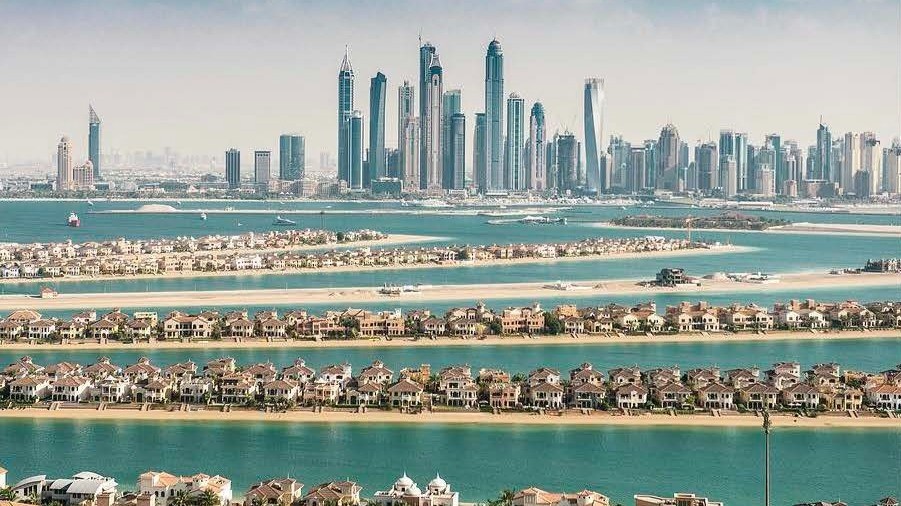
One of this week's most quietly significant stories comes from Al Sufouh. Trucks and construction equipment are moving at the site formerly occupied by Dubai Pearl — one of the emirate's most storied stalled projects, located at the base of Palm Jumeirah's land reclamation scheme.
Dubai Pearl's original conception dates back nearly two decades. Its return to active site movement is a signal worth watching. Stalled mega-projects resuming in Dubai have historically preceded renewed pricing momentum in their surrounding micro-markets. Al Sufouh, already one of Dubai's better-connected corridors, now has a large-scale development catalyst returning to its doorstep.
Dubai drops off the world's most expensive cities list
Julius Baer's latest wealth report ranked Dubai 14th globally — a positioning that reflects something specific: relative cost advantage, not decline. The emirate's dollar-pegged currency, prime real estate value relative to comparable global cities, and continued appeal as a stable wealth hub are the variables behind the ranking.
For international buyers comparing Dubai to London, Singapore, Hong Kong, or Monaco, the implication is straightforward: Dubai delivers comparable lifestyle infrastructure at a fraction of the cost. That gap is a structural advantage, not a temporary condition, and it continues to drive wealth migration and family office formation in the emirate.
Demand is waterfront — and willing to pay for it
A survey published this week found that 82% of UAE residents would consider seafront or marina communities for their next property purchase, with nearly all respondents willing to pay a premium for sea access. Respondents tied waterfront living to wellbeing, walkability, long-term value, and Dubai's broader liveability narrative.
This data point matters for advisory purposes. When buyer preference is this concentrated around a specific asset type, the premium commanded by waterfront and marina-adjacent properties is not speculative — it is demand-backed. For investors seeking rental outperformance or capital growth above market average, waterfront positioning remains the most defensible thesis in Dubai's residential market.
The hospitality proxy
A final data point deserves attention, even for those focused purely on residential real estate. Minor Hotels reported a 143% rise in late-June room nights and 575% growth in international wholesale bookings following the rebound in regional travel confidence. Eid Al Adha revenue rose 23%. Q3 rates are pacing 17.1% above last year.
Hotel performance is one of the most reliable leading indicators of real estate demand in Dubai. Tourism volume drives short-term rental yields. Business travel drives commercial leasing. Lifestyle tourism drives residential interest from international buyers who first experience the city as visitors. When hospitality numbers move this sharply, residential demand typically follows within one to two quarters.
The takeaway
July 7 presented three stories running simultaneously: institutional confidence in development land at scale; retail buyer conviction in off-plan apartments; and the return of a long-dormant mega-project that could reshape its surrounding micro-market. Underneath all three sits a city that has dropped off the most-expensive-cities list precisely because it has become more attractive — more infrastructure, more lifestyle, more institutional depth — without losing its relative value proposition.
For buyers and investors currently evaluating Dubai, these aren't isolated headlines. They are the same story told from different angles.
Data references: Dubai Land Department, Julius Baer, Arabian Business, Emirates 24/7, Zawya, Gulf News — 7–8 July 2026.
For a tailored read on how current market conditions apply to your acquisition or portfolio strategy, reach out directly.
#DubaiRealEstate #AumeraEstates #LuxuryRealEstate #DubaiInvestment #RealEstateAdvisory #UAEMarket #DubaiProperty
This editorial note is general information, not legal, tax, financial, or investment advice. Project terms and buyer circumstances require independent verification before commitment.